The Operator’s Read
The five leaks that stall DTC brands after $1M
Before I started Good On, I spent years in-house as a marketing manager. Fortune 500s, and small brands fighting to punch above their weight. One of them was a menswear label. Ten years in business, stocked in national retail chains and independent stores across the country. A real brand with a real following. And online, we could not crack $1M.
It took us a while to see why. Almost all of our online revenue came from customers who already knew us. We were living off our existing base. Every time we pushed for net-new customers, the CAC was brutal and the math fell apart.
That’s the same trap that stalls brands at $5M. It shows up at every ceiling, and $1M to $5M is where it bites hardest, because that’s exactly where founder instinct stops being enough and you need a system instead. The thing that got you here quietly caps you. Here are the five reasons it happens, and what the brands that broke through actually did about it.
The messy middle: $1M to $5M is its own game
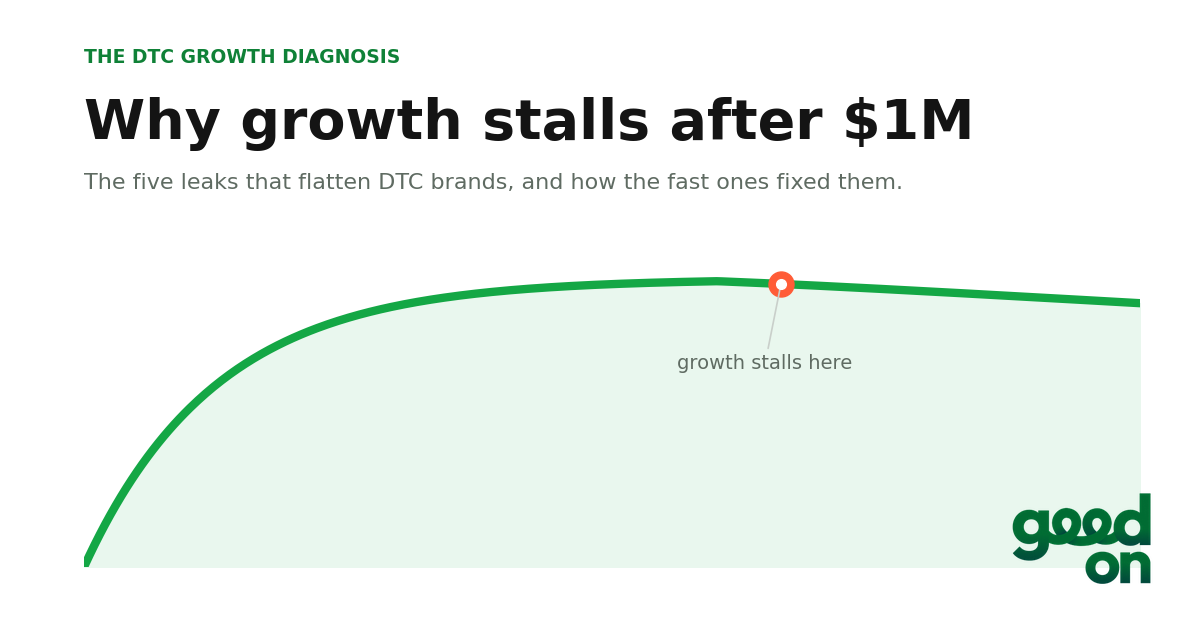
Getting to your first million proves one thing works. Scaling past it means building a system that keeps working as costs rise and audiences saturate. Different skill entirely. Your account still “works,” your product still sells, but growth drifts flat and you spend more just to stand still. That’s tactics running out of road.
Reason 1: You’re managing numbers that are lying to you
This is the one that hides all the others, so it goes first. As you scale, you stop buying your cheapest, highest-intent customers and start reaching colder audiences, so your CAC climbs. That part is normal. The real problem is you often can’t even see it, because you’re reading the wrong numbers.
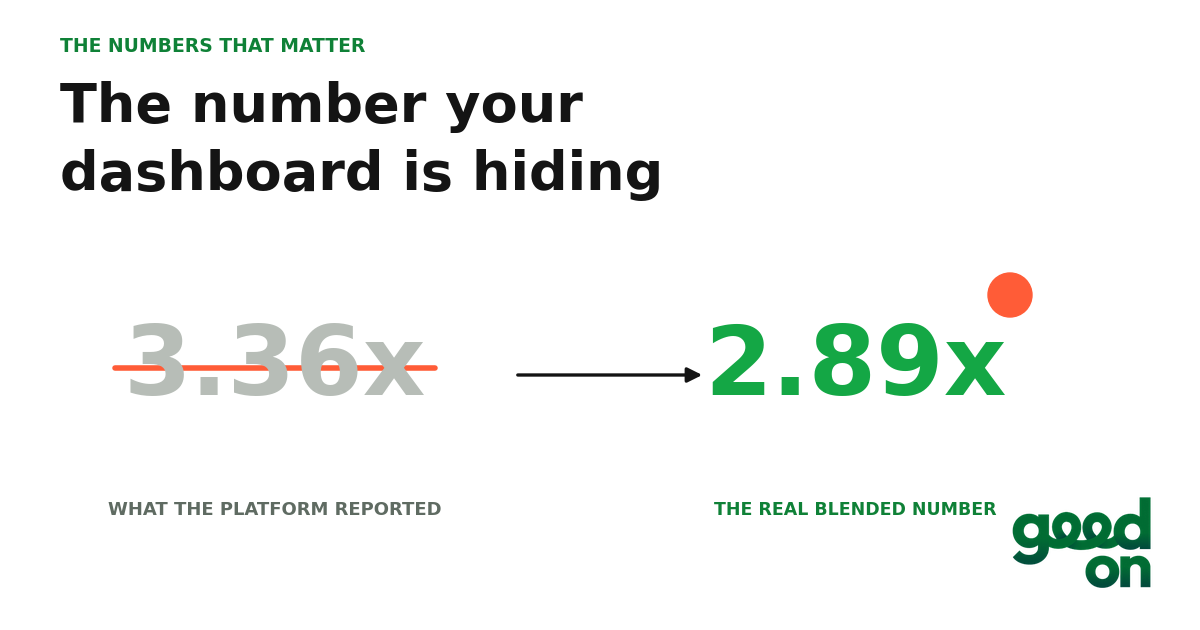
Most founders judge the account on a single campaign’s ROAS. That number lies. I once audited a brand certain it was running a 3.36 ROAS. Blended across every channel, the real number was 2.89, with a $70+ CPA and a 5.21 frequency. A frequency of 5.21 means you’re not advertising anymore. You’re stalking the customers you already have, which is exactly what that menswear brand was doing without realizing it.
So measure the things that tell the truth. Blended MER (total revenue divided by total ad spend) and contribution margin after ad spend, not the ROAS of your favorite campaign. And at this stage, put in a real cross-platform attribution tool, something like Triple Whale or Northbeam, so you can see what’s actually driving revenue across Meta, Google, email, and organic. You can’t fix a number you can’t see.
Reason 2: You’re acquiring customers but not keeping them
Under $1M, acquisition hides weak retention. Past $1M it can’t. Repeat rate stuck in the mid-teens and thin email and SMS revenue means you’re renting growth, refilling a leaky bucket with paid traffic every month.
Olipop is the opposite. Under $1M in 2019 to around $400M in 2024, and everyone points at the cans. I point at the numbers underneath. Roughly a 50% repeat purchase rate, over 70% of subscribers using skip and swap, and marketing spend under 10% of revenue as they scaled. That’s a retention story, not a paid one. Retention is the cheapest lever you’re not pulling, and it fixes your CAC math too, because a customer worth more lets you pay more to get the next one.
Reason 3: It’s the creative, not the algorithm
Performance dips and everyone blames targeting. Nine times out of ten it’s creative fatigue. The ads that got you to $1M decay as more people see them, and without a pipeline of fresh concepts, performance erodes no matter how clean the account is.
True Classic gets this. They ship around 44 new creatives a week and run close to 1,000 active ads on Meta, testing the first three seconds like a science. That’s how a t-shirt brand hit over $500M in lifetime sales. Not one viral ad. A machine. At scale, creative is your targeting. (More in why Meta ads stop scaling and what actually fixes it.)
Get the operator’s read, every month
The Good Word. What I’m seeing across $2M+ in DTC ad spend, in plain English. No fluff, no pitch.
Subscribe to The Good WordReason 4: You’re running ads tactically, with no system behind them
This is the root cause under the rest. Most founder-led brands scale on instinct. Launch, react, repeat. Fine, until the moving parts outgrow what one person can hold in their head. Then testing goes random, learnings don’t compound, and every month restarts from zero. A system replaces guessing with a loop: test, read the data, scale winners, kill losers, feed it back into creative and funnel.
Reason 5: Your funnel hit its current conversion ceiling
You can only push so much traffic through a landing page before conversion rate becomes the cap. Site converts at 1.5% and you’ve maxed the efficient audiences? More spend just buys pricier traffic hitting the same wall. The fastest win isn’t in the ad account at all. It’s in the offer, the page, and what happens after the click.
What healthy actually looks like by stage
Numbers move a lot by category and margin, so treat these as directional. These are the ranges we see across the DTC accounts we run, cross-referenced with public data. For context, the average DTC repeat purchase rate sits around 25 to 30% (grocery runs far higher, luxury far lower), so a mid-teens rate past $1M is a real signal, not a rounding error.
| Signal | $250K-$1M | $1M-$3M | $3M-$5M |
|---|---|---|---|
| Blended MER (revenue / total ad spend) | 3.5-5x | 2.5-3.5x | 2-3x |
| Repeat purchase rate | 15-25% | 25-35% | 35%+ |
| Email & SMS % of revenue | 10-20% | 20-30% | 25-35% |
| Paid media as % of revenue | 15-25% | 12-20% | 10-18% |
| Contribution margin after ad spend | 20%+ | 25%+ | 30%+ |

Save or share this. MER is supposed to compress as you scale, that’s physics, not failure. What should go up is retention and the share of revenue from your owned channels. If yours are moving the other way, you just found your leak.
How to tell which one is you
Quick check. The box you tick first is usually where the real constraint lives.
- Blended MER falling, margin thin, and you’re not sure why? Your numbers (Reason 1).
- Repeat rate under ~20%, owned channels quiet? Retention (Reason 2).
- New ads flop, old ones fading? Creative pipeline (Reason 3).
- Every month feels like starting over? No system (Reason 4).
- Traffic’s fine but conversions aren’t? Funnel or offer ceiling (Reason 5).
Want the full 12-point version?
Download the free DTC Growth Audit Checklist, the same one we run on client accounts before we touch a dollar of spend. Or if you’d rather we find your leak for you, book a free 15-minute audit.
Get the free checklistWhat the fast ones actually did
I won’t promise you a magic 4x. I’d rather set a conservative target and beat it. Here’s what actually breaks the ceiling, and it’s all of these at once, not one silver bullet. (Reason 1 is the first move: get your measurement honest before you touch anything else.)
1. Hire the right team, not the wrong one
Not a pile of cheap freelancers with no system between them. And not a bloated big agency that quietly drains your budget on retainer while a junior learns on your account. You want a right-sized specialist team that owns the whole loop and is accountable for the blended number.
2. Find your hero product
By now you should know your one scalable product, the thing people reorder without thinking. Jones Road built $20M in its first year around one hero product, the Miracle Balm. True Classic built a nine-figure brand around the perfect crew-neck tee. For a drink brand it might be the one flavour everyone comes back for, the way Olipop leads with its flagship. Pick the horse and ride it, don’t spread thin across the whole catalog.
3. Retain before you acquire
It’s cheaper and it improves your acquisition math immediately. Email, SMS, subscription, the boring flows that compound. Get a real retention platform like Klaviyo doing the heavy lifting: welcome, browse abandon, post-purchase, winback. This is the exact lever the menswear brand never pulled.
4. Build a community, not just ads
Your organic social and direct reach matter as much as paid. A strong community catapults everything paid does, because ads pointed at a brand people already love convert on a different level. Jones Road scaled largely on organic and genuine word of mouth before it leaned hard on paid. Build the audience that ads then amplify.
5. Invest in real branding
Packaging, story, the way you make someone feel when they open the box. Figure out what you actually stand for. That’s what makes a hero product spread and what makes your ads land instead of scroll past.
6. Then systematize it
We call ours the Impulse Engine. Test, scale, retain, repeat. Not clever, just repeatable, and repeatable is what compounds. When something’s working, don’t get soft on it. We’ve scaled proven winners hard, backpacks sitting around an 11 ROAS on Meta, because the time to be aggressive is when the data already says yes.
True Classic didn’t out-spend anyone. Olipop didn’t out-luck anyone. They out-systemized everyone. More budget into a broken funnel just loses money faster. Fix the system first.
Frequently asked questions
Why do DTC brands stall between $1M and $5M?
Because the thing that got you there has a ceiling. A couple of winning products, founder instinct, a few good ad sets, and heavy reliance on the customers you already have. Past a point, rising CAC, weak retention, creative fatigue, and no real system all leak at once. Growth just goes flat.
Is a falling ROAS normal as I scale?
Yes. Spend more and you’re buying colder, pricier customers, so marginal ROAS drops. Judge the business by blended MER and contribution margin, not one campaign. Get real cross-platform attribution (something like Triple Whale or Northbeam) so you see the true number.
How do I know if it’s acquisition or retention?
Check repeat purchase rate and how much revenue comes from email and SMS. The DTC average is around 25 to 30%, so a mid-teens rate past $1M, with owned channels under about 15% of revenue, means your leak is retention. Olipop runs a repeat rate near 50%.
What’s a healthy CAC for a DTC brand?
No magic number. It depends on your AOV and margin. Keep blended CAC well under your 12-month customer value, and stay positive on contribution margin after ad spend, usually 20% or more.
How long does it take to break through?
Fixing the foundation (attribution, creative pipeline, retention flows, a real testing system) usually shows up in 60 to 90 days. It’s a system change, not a single campaign.
Not sure which of the five is holding you back?
Book a free 15-minute ad audit. We’ll review your account, name your top 3 budget leaks, and tell you the fastest way through. No pitch, no obligation.
Book your free audit